


Points clés à retenir
- AI adoption in smart traffic management is operational, not experimental, but remains uneven across agencies due to data quality gaps, security concerns, workforce shortages, and defensibility requirements.
- The agencies seeing the strongest results are applying intelligent traffic systems to operations analysis, proactive road safety, maintenance prioritization, and signal performance optimization using real-time data and machine learning.
- Trust matters more than raw accuracy. AI tools for traffic management must produce traceable, auditable recommendations tied to verifiable source data, not black-box outputs.
- Mateo, Miovision's agentic AI system inside the Miovision One platform, is built to close the trust gap with transparent, defensible, engineer-ready insights across the full transportation network.
What the AASHTO survey reveals about where adoption is stalling, and what it will take to cross the data chasm
AI adoption in smart traffic management is no longer theoretical. It’s operational. This guide breaks down the AI adoption challenges slowing agency adoption, what the AASHTO data reveals, and how intelligent traffic systems are closing the gap between insight and action.
For most of the last decade, the conversation about AI in transportation has been dominated by autonomous vehicles. But the real story, the one happening inside public agencies right now and the one this guide from Miovision explores, is far more practical.
AI is no longer experimental in smart traffic management. It’s operational, and the gap between agencies that have figured out how to use it and agencies that haven’t is widening fast.
The American Association of State Highway and Transportation Officials (AASHTO) conducted a nationwide survey of State Departments of Transportation (DOTs) to determine where AI adoption stands. The survey received 76 responses from 51 State DOTs across all U.S. regions.
The results, published as an interactive dashboard by the National Operations Center of Excellence (NOCoE), are the clearest picture we have of what’s working, what’s not, and where the friction lives.
If you read between the lines of that data, a pattern emerges. The technology is ready. The agencies want to move, yet adoption is uneven, slower than the hype cycle would suggest, and concentrated in a handful of use cases.
The question is why.
The state of adoption: Real, but uneven
A few things are clear from the AASHTO findings.
Most State DOTs are using AI in some form.
Computer vision and adaptive signal control are increasingly common in larger transportation networks, especially growth corridors and metros running Vision Zero programs. Smart traffic systems are being deployed, but not uniformly or always where they’re needed most.
The AASHTO survey data provides specific metrics for these deployment trends.
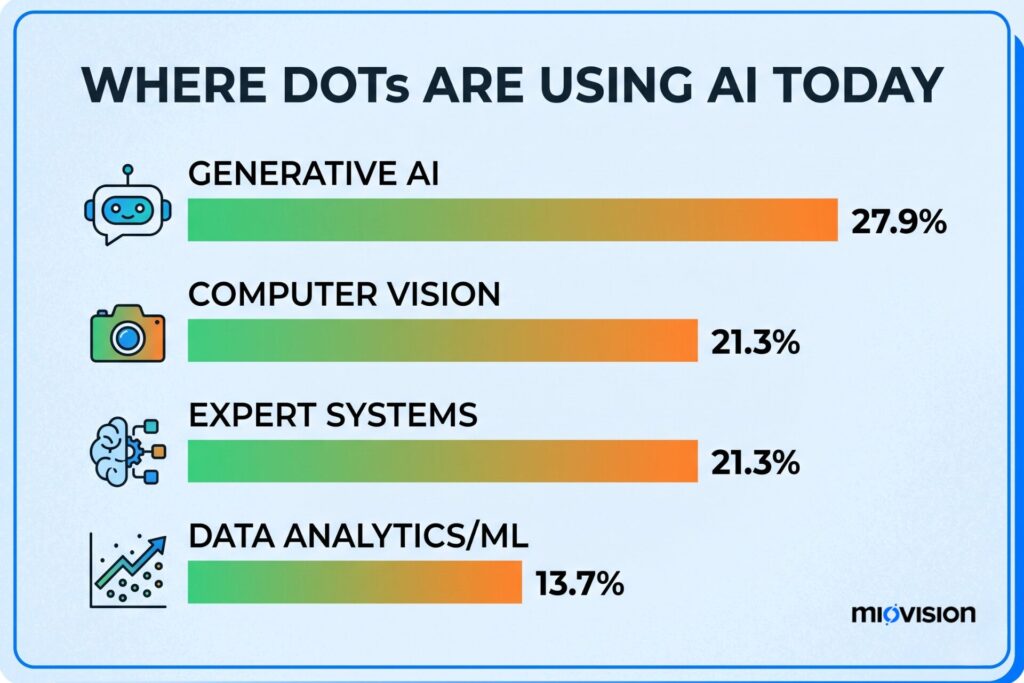
- Generative AI is currently the most used tool, reported by 27.9% of agencies.
- Computer vision and expert systems are nearly as common at 21.3%.
- Standalone data analytics and machine learning platforms are used by 13.7% of respondents.
A critical reality is apparent in this breakdown: despite the industry’s focus on complex operational models, AI’s immediate, practical presence within state agencies is overwhelmingly concentrated on front-end language tools and administrative automation.
The places where AI is delivering the most value are narrower than vendor marketing suggests. DOTs report the strongest results in signal optimization, safety analysis, and incident detection.
The use cases that demand the most defensibility, the ones where a recommendation carries legal or political weight, are exactly where adoption slows.
This isn’t a technology gap. It’s a trust gap.
The four AI adoption challenges slowing things down
The AASHTO survey revealed four key areas acting as barriers to AI adoption, according to State DOTs. Interestingly, these obstacles differ from those most frequently discussed in the industry trade press.
1. Data Quality
Most agencies already have plenty of data. What they lack is data they trust. Controller telemetry, ATSPM (Automated Traffic Signal Performance Measures) logs, video analytics, and third-party probe data are stored in separate systems with varying update cadences.
When a recommendation comes out of an intelligent traffic management system, an engineer needs to be able to ask: where did this number come from, when was it captured, and is it consistent with what the controller logs show?
Most current AI tools can’t answer that question cleanly. That alone is enough to stall adoption inside a careful engineering culture. Without reliable real-time data flowing into smart traffic management systems, even the best machine learning models can’t produce recommendations that engineers are willing to act on.
2. Reliability and Defensibility
An AI recommendation that an engineer can’t explain to a council, a mayor, or a courtroom isn’t a usable recommendation. Engineers know this. The bar for AI in traffic management isn’t “Is the answer probably right?” It’s “Can you defend it?”
This is especially true for decisions that affect traffic conditions on high-volume corridors, school zones, or public transit routes, where the consequences of getting it wrong are felt immediately and publicly.
3. Workforce Gaps
The pipeline of new signal engineers is thinner than the retirement curve. Agencies are being asked to manage larger, more complex transportation systems with fewer experienced staff. AI is sometimes pitched as a solution to this problem, but a tool that requires its own learning curve, its own data science skill, or its own dashboard-building effort just shifts the staffing problem rather than solving it.
Smart transportation tools need to lower the barrier to insight, not raise it.
4. Security Risk
Public infrastructure is a sensitive target. Any tool that touches signal systems, especially one that connects to a cloud service, raises legitimate questions about access control, data residency, and the exposure of sensitive information. DOTs are right to ask these questions, and right to move carefully until they get clean answers.
These aren’t abstract concerns. They show up in every adoption conversation between vendors and DOTs. The agencies that cross the chasm successfully do so when the tool addresses these four barriers directly, not when it works around them.
Why trust and defensibility are the actual unlock
If there’s a single insight worth taking away from the AASHTO data, it’s this: AI adoption in traffic engineering is gated by accountability, not capability.
Signal engineers are personally accountable for the timing changes they recommend. If a change improves traffic flow, they own that success. Conversely, if it causes a queue spillback leading to a crash, that responsibility also falls on them.
AI adoption doesn’t shift this accountability; rather, it increases it. The engineer is now responsible not only for the change itself but also for the critical decision to trust the AI tool that suggested it.
That’s why traceability matters more than raw accuracy in smart traffic management. An AI tool that’s right 95% of the time but can’t show its work is less useful in a public agency than a tool that’s right 85% of the time and produces an auditable trail back to the source data. The former gets shelved. The latter serves as the engineer’s starting point and is edited to be 100% defensible by their standards.
Any serious AI tool for traffic operations must clear a high bar. Its underlying logic must align with established federal frameworks, including the Federal Highway Administration (FHWA) operational guidelines, the Manual on Uniform Traffic Control Devices (MUTCD) compliance standards, and the Institute of Transportation Engineers (ITE) signal timing principles.
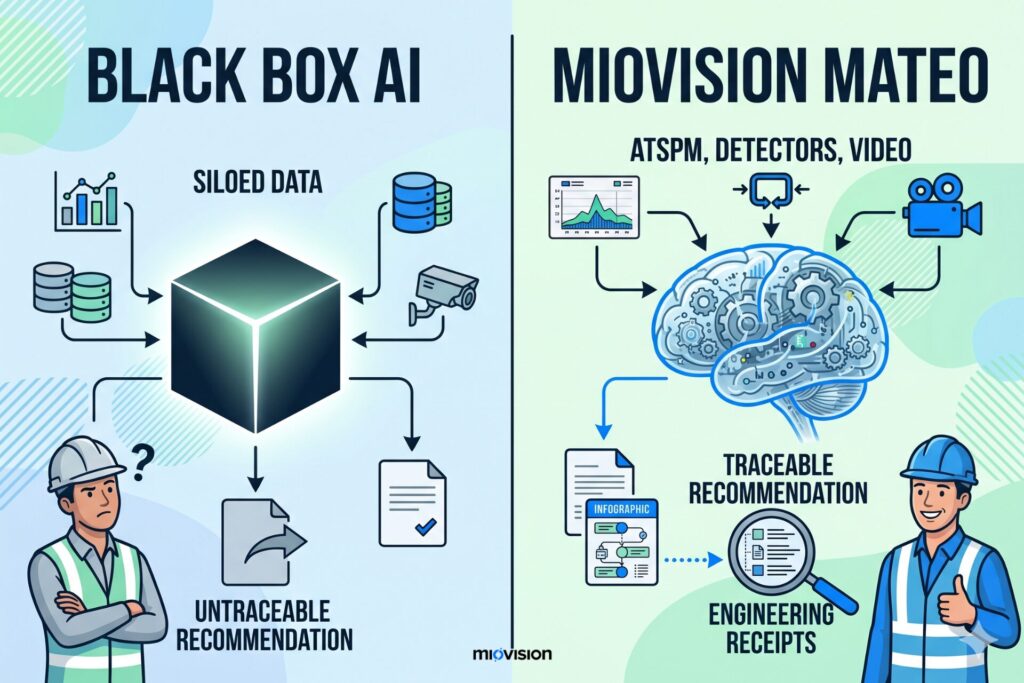
For traffic engineers to approve automated changes on critical corridors, the AI’s recommendations must be fully auditable and traceable. They need a definitive answer to the question “Where did this come from?” that can be traced directly back to verifiable ATSPMs, raw detector logs, video telemetry, and other integrated analytics tools.
This is about the daily reality of public accountability. When data is transparent and auditable, it changes the nature of the conversation between a city and the public it serves.
Case Study: Disarming the Citizen ComplaintA municipal traffic engineer received an email from a local resident furious about a newly implemented No Right Turn on Red restriction at a busy intersection. Rather than spending hours digging through archived corridor studies and safety audits to draft a defensive reply, the engineer opened Mateo, the Miovision GenAI Agent, and pasted the complaint directly into the platform. The system quickly understood the operational logic of the specific intersection geometry because it doesn’t function as a black box. It calculated the minor increase in peak-hour delay for right-turning vehicles and then balanced this against a significant and measurable reduction in pedestrian-vehicle conflict points at the crosswalk. Armed with that synthesis, the engineer sent back a detailed, localized response, walking the resident through the precise engineering trade-offs behind the decision. The resident’s initial surprise at receiving a response from a city department gave way to acceptance. The explanation’s transparency and analytical depth completely disarmed them, leading them to accept the restriction without further argument. This outcome demonstrates the power of AI tools as force multipliers for engineering defensibility, going beyond mere automated text generation. The agency achieved more than simply closing a service ticket. They turned a public relations liability into a demonstration of civic trust. |
What “AI you can use” looks like in operations
The agencies getting real value from smart traffic systems today use them in a few specific ways.
Operations Analysis and Reporting
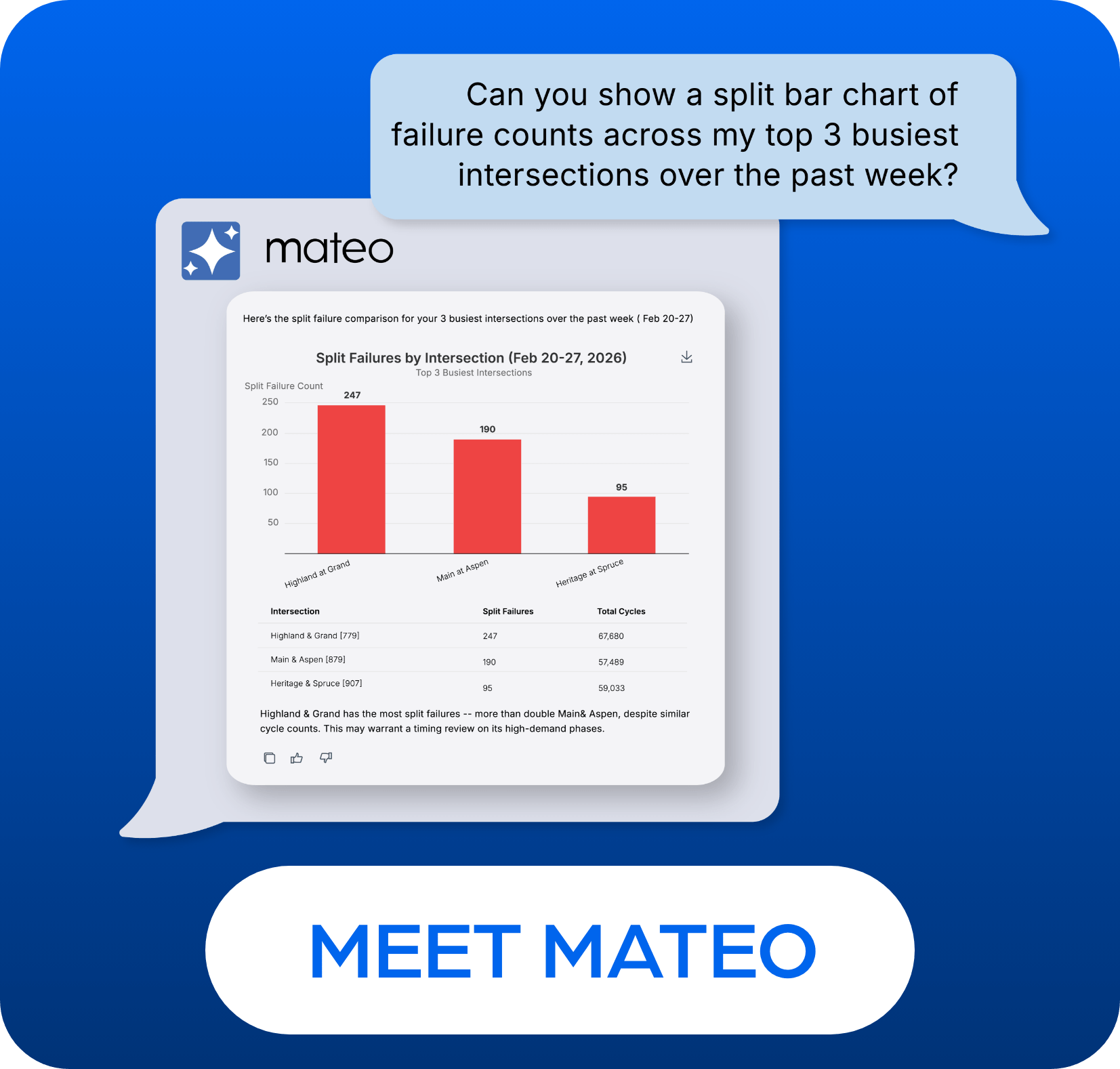
Instead of building manual dashboards every time a council member asks about a corridor, engineers can query real-time data directly. The AI generates charts, maps, and supporting tables in response to plain-language questions about traffic conditions.
With emerging AI studio environments, agencies can go a step further by using natural language queries to build and edit custom operational workspaces, dashboards, and reports, essentially creating their own interfaces to their data and applications. The time that used to go into report-building goes back into engineering judgment.
Predictive analytics is increasingly central to this workflow, enabling agencies to anticipate where traffic flow will degrade before it becomes a problem visible to the public.
Sécurité préventive
AI tools are transforming road safety from reactive to proactive. By analyzing near-miss patterns, pedestrian volumes, and vehicle conflict points, machine learning models can identify high-conflict intersections before they result in serious crashes.
These models are trained on historical incident data to surface locations with an elevated road safety risk, enabling interventions sooner rather than later.
It’s a significant shift for vulnerable road users, such as pedestrians, cyclists, and public transit riders, because it allows agencies to move from merely reacting to harm to actively preventing it.
Maintenance Efficiency
AI can rank intersections for field visits based on video detection system reliability, camera health, and recent performance anomalies. A technician’s truck roll becomes a prioritized list, not a guess. Agencies managing large transportation networks with lean teams find this kind of triage especially valuable.
Accelerating Citizen Complaint Resolution
By integrating municipal 311 or citizen reporting platforms directly with network data, AI Agents can automatically cross-reference resident complaints against actual intersection telemetry. This allows agencies to instantly validate and triage operational issues, suggest targeted mitigations, and even draft data-backed replies to the public, transforming a slow administrative burden into a rapid, responsive workflow.
Signal Performance Optimization
By analyzing cycle lengths, phase splits, and arrival patterns, AI can flag corridors where coordination has drifted, identify recurring split failures, and provide a first-pass investigation for an engineer to validate or override.
Optimizing traffic signal timings at scale, across a full network, is one of the clearest and most defensible applications of machine learning in traffic management today.
None of these uses replaces engineering judgment. All of them give engineers more leverage on the judgment they already have.
The Find and Fix workflow, in practice
The shared pattern across these use cases is the Find and Fix workflow. It has four steps.
- Identify. Ask the AI to scan the network and surface where performance is degrading. Not “is anything wrong,” but “where, specifically, should I be looking this week?”
- Diagnose. Drill into the root cause. A corridor running slowly at PM peak might be experiencing split failures at one approach, a detector outage at another, or upstream queuing from a third intersection. The AI walks the data back to the source, drawing on real-time insights from across the network.
- Resolve. Apply the fix. Sometimes a timing adjustment, sometimes a hardware repair, sometimes a coordination plan revision.
- Validate. Measure post-fix performance against the pre-fix baseline. Confirm the change worked. Document it for the next engineer who inherits the corridor.
The workflow itself isn’t new. Good signal engineers have been doing this manually for years. With AI, the time it takes to complete a cycle changes. A diagnostic process that used to take days or even weeks of pulling logs and writing custom scripts has been compressed into a conversation that takes seconds and minutes.
A Real-World Example: Scoping a Pedestrian Safety ProjectOne agency used smart traffic management tools to build a presentation pitching a critical pedestrian safety project. Historically, defining a project scope of this scale has required weeks of manual data harvesting: pulling historical safety audits, parsing volumes, and attempting to isolate anomalies such as seasonal shifts or local event traffic. Instead, the agency used Mateo to aggregate and analyze multi-layered datasets across specific time frames and special event windows. They were able to hand their consulting partners a precisely targeted project scope immediately. What typically becomes a multi-week administrative cycle was condensed into a single, data-backed pitch deck, enabling the project to move from concept to design at a fraction of the traditional timeline. |
Where Mateo fits
This is the gap Miovision built Mateo to close. Mateo is an Agentic GenAI system purpose-built for traffic engineering, available as a conversational interface inside the Miovision One platform. It speaks the language of National Electrical Manufacturers Association (NEMA) phases and ITE timing standards. Every recommendation it surfaces is tied back to the underlying data, so engineers can defend it.
Mateo works across the full Miovision One network, including hardware telemetry, video analytics, and integrated third-party data. Engineers aren’t asking the AI to reconcile siloed sources before they get an answer. The data collected across the network feeds directly into the analysis, producing actionable insights rather than raw outputs that still require manual interpretation.
The point of Mateo isn’t to replace engineering judgment, but to give small teams the leverage they need to manage growing transportation networks with the staffing they have. It aims to turn a five-person operations group into a team that can investigate, diagnose, and act on every corridor in their jurisdiction, every week, with the defensibility their work requires.
Opening the Black Box: The Audit Trail
When an engineer clicks into a recommendation that Mateo surfaces, they get a definitive audit trail. No vague summaries or hallucinations.
Where the AI Stops By Design
To earn the trust of a naturally skeptical traffic engineering audience, it’s equally important to be clear about what Mateo can’t do.
Today, Mateo can’t make changes to devices, infrastructure, or signal timing. It doesn’t log into controllers, overwrite local splits, or dynamically push a timing plan to the street on its own.
Mateo is an investigator, not an operator. It brings the engineer all the way to the 99-yard line, diagnosing the exact operational bottleneck, synthesizing multi-layered data, and informing exactly what a traffic engineer could do to fix the problem.
But it stops short of the goal line. A professional engineer must review the logic, validate the trade-offs, and complete the change.
While future iterations will make the handoff between insight and execution smoother, the core philosophy is non-negotiable: a human in the loop is mandatory for the final decision.
Crossing the chasm
The data chasm is real. So is the path across it.
The AASHTO findings make clear that AI in traffic engineering is no longer a future conversation. It’s a present-tense operational question, with present-tense barriers that the right tool can address.
Intelligent transportation systems are already improving road safety, reducing traffic congestion, and helping city planners make better infrastructure investment decisions. The gap is closing, but not evenly.
The agencies that get this right won’t be the ones that adopt the most AI. They’ll be the ones who adopt AI they can trust, defend, and put to work without rebuilding their organization around it.
Intelligent traffic management systems aren’t about replacing the expertise of the people managing these networks. It’s about giving them better tools to do what they already do well, at the scale that modern urban mobility demands.
FAQs about AI in traffic engineering
What is Mateo, and how do I access it?
Mateo is the industry’s first GenAI agent built specifically for traffic engineering, available as a conversational interface inside the Miovision One platform.
What is a smart traffic control system?
A smart traffic control system is an advanced network of hardware and software that uses real-time data, Artificial Intelligence (AI), and the Internet of Things (IoT) to monitor, analyze, and optimize traffic flow. Unlike fixed-time signals, smart traffic management systems adjust signal timings dynamically based on actual traffic conditions, reducing congestion and improving safety.
How does Mateo handle defensibility?
Every recommendation links back to its source data, giving engineers a traceable audit trail for legal review, public hearings, or internal audits.
What are the four types of traffic control?
The four primary types are traffic signals, signs, pavement markings, and roundabouts or channelization. Smart traffic management builds on signalized control, particularly by using AI and real-time data to make traffic signals responsive to live traffic conditions rather than running on fixed schedules.
Can Mateo help justify budget requests to Council?
Yes. Mateo converts technical performance data into plain-language summaries that translate engineering work into terms non-technical decision-makers can act on. Mateo can also build custom workspaces for grant applications like the Safe Streets and Roads for All (SS4A) Grant Program using AI Studio.
How secure are smart traffic systems?
Responsible smart traffic systems are built with access controls, data residency policies, and strict handling of sensitive information. Agencies should require vendors to provide clear documentation on compliance posture, cloud architecture, and exposure to external endpoints before deployment.
Are smart traffic systems expensive?
The upfront investment in intelligent transportation systems varies, but adaptive signal control and related ITS tools can deliver meaningful long-term benefits by reducing delay, travel time, fuel use, and emissions. FHWA case studies have found travel-time reductions of roughly 13% to 25% in some deployments, with delay reductions of 19% to 44% in others.
Crossing the data chasm starts with the right tool
Mateo and AI Studio are available today, built to help agencies work through the AI adoption challenges holding them back, without asking teams to rebuild around a new system. Book a demo or start a pilot to see it on your own network.