



Opticom TSP · Trusted for 60+ Years
Keep Transit On Schedule with Signal Priority That Delivers
Miovision Opticom Transit Signal Priority gives buses and light rail conditional priority at intersections, reducing delays and improving schedule adherence without disrupting normal signal operation.

 Feuerwehren
  Polizeibehörden
  Rettungsdienst & Krankenwagen
  Verkehrsbetriebe
  Kommunale Verkehrsämter
  Behörden der Bundesstaaten und Provinzen
 Vertrauen genießen bei






Does this sound familiar?
When transit falls behind, everyone feels it
As cities grow in population and congestion, transit agencies need to keep up with reliable and efficient public transit systems. Providing reliable, on-time transit with Opticom’s Transit Signal Priority solution can improve ridership and rider satisfaction, and give agencies the tools to stay efficient and maintain schedule adherence.

Transit delays disrupt schedules
Your buses are frequently behind schedule. Constant delays at intersections disrupt timetables, erode rider trust, and push on-time performance KPIs further out of reach.

Long commutes hurt ridership
Unnecessary stops at red lights and unoptimized signal timing make commutes excessively long. Riders look for alternatives and ridership numbers drop, undermining the case for transit investment, and adding more congestion to roads.

Increased fuel costs add up
Excessive idle time at signalized intersections leads to higher fuel consumption across the fleet, raising the cost of doing business, increasing gas emissions, and pushing operational budgets out of balance.
So funktioniert es
How Opticom TSP works
Priority is requested only when needed
Opticom TSP adjusts signal timing within the normal signal cycle to help buses and light rail stay on schedule. Priority is triggered only when business logic says it is needed, protecting signal coordination for the broader network.
The vehicle approaches the intersection
Priority is requested only when needed Opticom TSP adjusts signal timing within the normal signal cycle to help buses and light rail stay on schedule. Priority is triggered only when business logic says it is needed, protecting signal coordination for the broader network.
Opticom checks conditions
Opticom compares the vehicle's data against configurable business logic, such as running one minute or more behind schedule. For cloud-connected fleets, this evaluation happens before any request reaches the signal controller, protecting engineered timing plans from unnecessary requests.
Opticom requests priority from the traffic controller
When conditions are met, Opticom sends a priority request to the traffic signal controller, cloud-connected vehicles trigger this automatically, while GPS-equipped vehicles send the request directly once in range. The controller extends the green phase or shortens the red just enough to help the vehicle through. The normal signal cycle continues, and cross-traffic disruption stays minimal.
TSP vs. traffic signal preemption: A traffic signal preemption system is reserved for emergency vehicles on active response. Transit signal priority works within the normal signal cycle, granting priority based on certain conditions such as schedule adherence and business logic. Both run on the Opticom platform.
What Opticom TSP Delivers
Four capabilities that keep your network on track Opticom TSP gives transit agencies real-time visibility, data-driven analytics, configurable priority logic, and fast cloud deployment, all on a single platform.
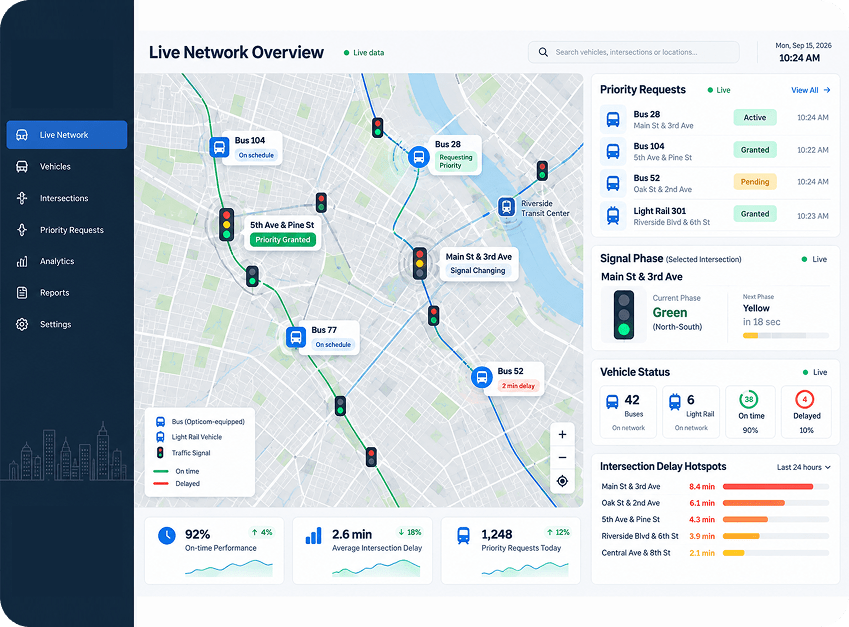
Real-time vehicle location and insights
See your Opticom system at work with live signal phase changes and priority requests. Get a real-time view of where Opticom-enabled buses are, whether they're requesting priority, and where delays are building on your network.
- Live view of Opticom-equipped buses and light rail vehicles
- Active priority requests and signal phase changes in real time
- Historical speed data to identify intersection delay hotspots

Data-driven decision making with Route Analytics
Route Analytics gives users an overview of Opticom-equipped routes and key average metrics, supporting decisions for route improvements, vehicle additions, and timing adjustments. Analytics flag areas of concern for further investigation, saving time on manual calculations.
- Signal delay per intersection and route
- Dwell time at stops
- Drive time between stops
- Total travel time per route

Set custom priority parameters
Traffic agencies are often hesitant to implement TSP because of concerns about signal coordination. Opticom addresses this directly: conditional parameters ensure that priority requests are triggered only when necessary, protecting engineered timing plans.
- Conditions based on schedule adherence threshold, such as running 1+ minute late
- Time of day and day of week rules
- Minimum occupancy thresholds
- Minimum headway between vehicles
The Redding Area Bus Authority (RABA) reduced average travel times per route by up to 15%, saving commuters 3.5 hours per month.

Faster deployment through Cloud
Cloud integrations from trusted third-party platforms reduce the time needed to deploy with minimal-to-no installations needed on vehicles. Use what is already on your vehicles to get up and running with Opticom TSP. Opticom can be deployed in days on top of existing, compatible cloud infrastructure. Deploy transit signal priority in days, not months. Cloud-native configurations with trusted integrations like Swiftly and GTFS Realtime, Opticom TSP leverages the infrastructure your agency already has. With options that eliminate proprietary hardware and lengthy vehicle installations, Opticom Cloud bypasses the costly, time-consuming delays of legacy roadside and line-of-sight systems.
- Trusted integrations with Swiftly and GTFS Realtime
- Vehicles do not need to be taken offline for installation
- Faster connectivity to vehicles and intersections, in weeks not months
- Vehicle work done remotely during scheduled downtime
Proof of performance
Real results from transit agencies running Opticom TSP
Capital District Transportation Authority (CDTA), New York
CDTA reduced signal delays by 43% across 143 intersections in four weeks Over four weeks and across 143 intersections, Miovision used Opticom TSP to minimize schedule delays, demonstrate TSP efficacy with data, and improve operational efficiency through collaboration with traffic engineering and operations teams.
Since the implementation of the Miovision Opticom product, we’ve reduced the number of emergency vehicle accidents while they’re responding to an emergency call. We’ve had zero accidents.
Chief Barnett, Kyle, Texas Police Department

Powered by Miovision One
Powered by Miovision One, Enhanced with AI

AI-powered insights for your transit network
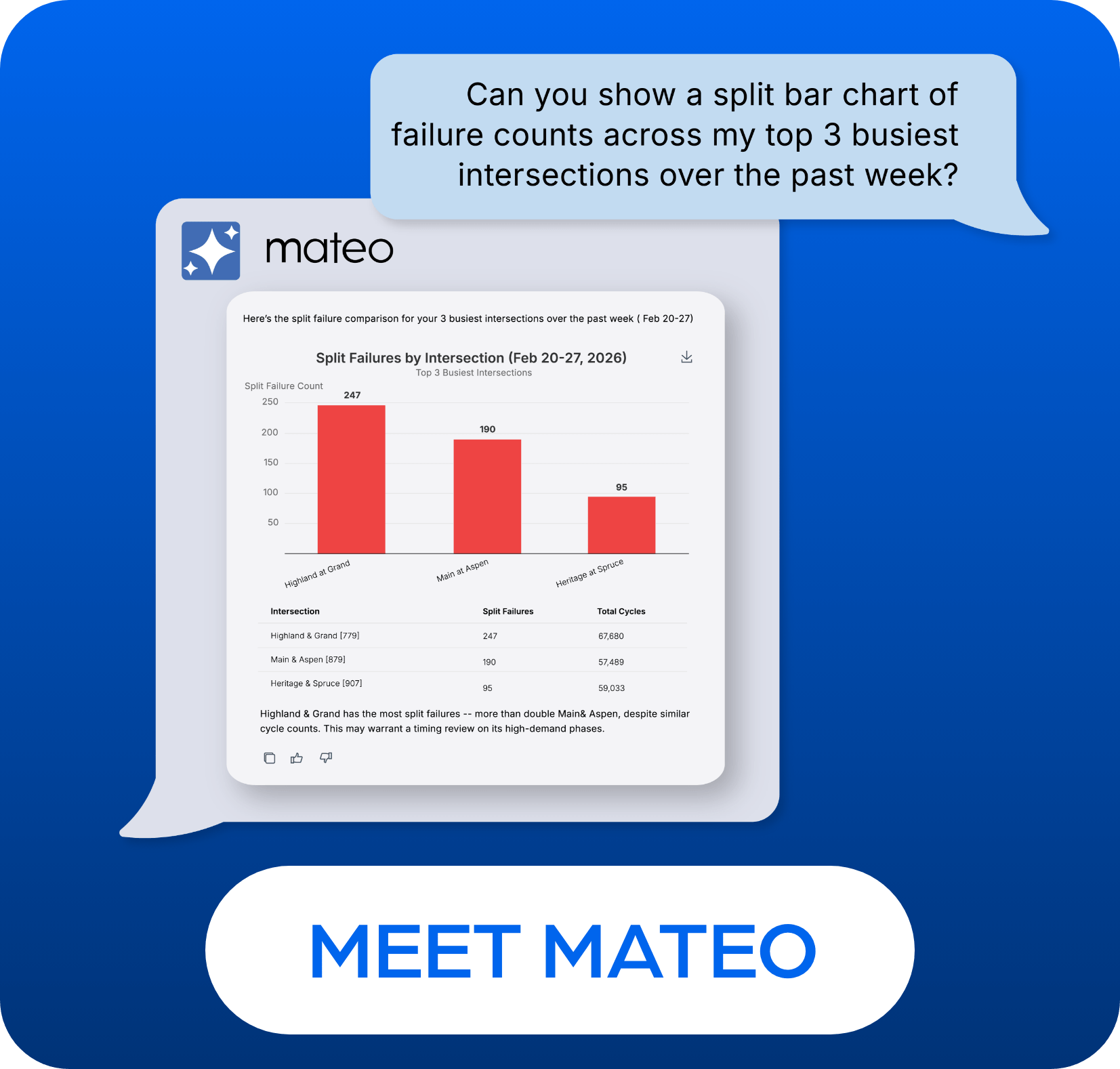
Unlock the full value of your Opticom TSP analytics with Mateo and AI Studio. As the world's first traffic-trained GenAI agent, Mateo works alongside AI Studio, a customizable layer within our platform, to give Opticom TSP customers interactive and customizable views of standard TSP data.
Learn About MateoTransit Priority Metrics
Ask Mateo why signal delay is high on a specific route and get an immediate, data-backed answer.
Operations Analysis
“Show me the intersections with the most TSP requests last week.” Answered in seconds, not hours.
Performance Reporting
Generate route performance summaries and executive-ready reports without manual data compilation.
Network Visibility
Mateo monitors your entire Miovision One ecosystem, including Opticom TSP performance, around the clock.
Who uses Opticom TSP
Opticom TSP serves those responsible for transit reliability, ridership, and operational efficiency at medium-to-large metropolitan transit agencies.

Transit Director of Operations
Schedule adherence is your most visible KPI. Opticom TSP gives transit vehicles conditional priority at intersections, reducing delays and cutting fuel costs without disrupting signal coordination.

Transit Procurement
Multiple purchasing options mean solutions work for your budget and infrastructure. Opticom is available through Sourcewell, Canoe, and direct purchase, with paths to grant funding for eligible agencies.

City IT Managers
Opticom Cloud uses already installed and trusted vehicle technology and proven cellular networks, integrating cleanly with the systems your agency already operates and supports.

City Traffic Engineers
Opticom's conditional priority logic respects your engineered timing plans. Priority is granted only when business logic says it's needed, and every event is logged for your review.

Transit Operations Managers
Opticom Route Analytics shows routes and intersections where vehicles are consistently delayed, replacing anecdotal feedback with data you can act on.

Fleet Managers
You can't afford lengthy installations that pull buses out of service. Opticom Cloud uses existing vehicle equipment so your fleet is minimally disrupted.
Beschaffung
Flexible paths to fund and deploy Opticom TSP Pre-competed contract vehicles and grant funding give transit agencies a faster path to deployment.

Sourcewell (Vereinigte Staaten)
Pre-competed cooperative purchasing that eliminates the separate bid process, accelerating timelines for transit agencies across the US.
Contract #: 030425-MIO
Kanu-Beschaffung (Kanada)
Canadian transit agencies can access Opticom TSP through Canoe, providing pre-competed access across all provinces.
Kanadische Behörden
Grant and Federal Funding
FTA, CMAQ, and state transit grants fund many Opticom TSP deployments. Our grants specialists know the funding landscape for your region.
FTA, CMAQ, State GrantsFrequently asked questions
Transit signal priority adjusts signal timing to help buses and light rail stay on schedule by extending green phases or shortening reds as those vehicles approach intersections. It works within the normal signal cycle using conditional logic, such as schedule adherence or minimum headway, and does not override signal operation the way emergency vehicle preemption does.
Opticom TSP sends a priority request from the transit vehicle to traffic signal controllers along the route. The controller checks the request against configurable business logic and grants priority against pre-defined criteria, for example when a bus is running behind schedule. The normal signal cycle continues, keeping cross-traffic disruption minimal.
No. Opticom uses conditional priority logic and priority can be granted only when business logic says it is needed, for example a bus running one minute or more behind schedule. The normal signal cycle continues and engineered signal coordination is protected. Traffic agencies maintain full control over the conditions under which priority is granted.
Cloud-based Opticom TSP can be deployed in days using existing vehicle hardware and trusted integrations like Swiftly and GTFS Realtime. Vehicles do not need to be taken offline. CDTA equipped 143 intersections in four weeks, reducing transit signal delays by 43%.
Explore more
The Opticom priority control ecosystem
Multiple purchasing options mean solutions work for you, whether through cooperative purchasing or grant funding.

Opticom EVP for First Responders
Traffic signal preemption for fire, police, and EMS. Reduce response times by up to 25% and intersection crashes by up to 70% on the same Opticom infrastructure.
Entdecken Sie Opticom EVP
Opticom für Schneepflüge
Conditional signal priority for snowplow operators, clearing roads for citizens faster after the worst storms.
Learn about fleet priority
Mateo by Miovision
The industry's first GenAI Agent for traffic engineering. Ask Mateo about your Opticom TSP metrics, route performance, and network health in plain language.
Learn about MateoGet started (contact)
Ready to keep your transit network on schedule?
Our Opticom specialists work with transit agencies, traffic engineering teams, and city operations groups. They understand your procurement process, your existing infrastructure, and the results agencies like yours have achieved with Opticom TSP.
Eine Demo buchen
Fill out the form and an Opticom specialist will be in touch shortly.
No spam. One call, one specialist, one focused conversation.