
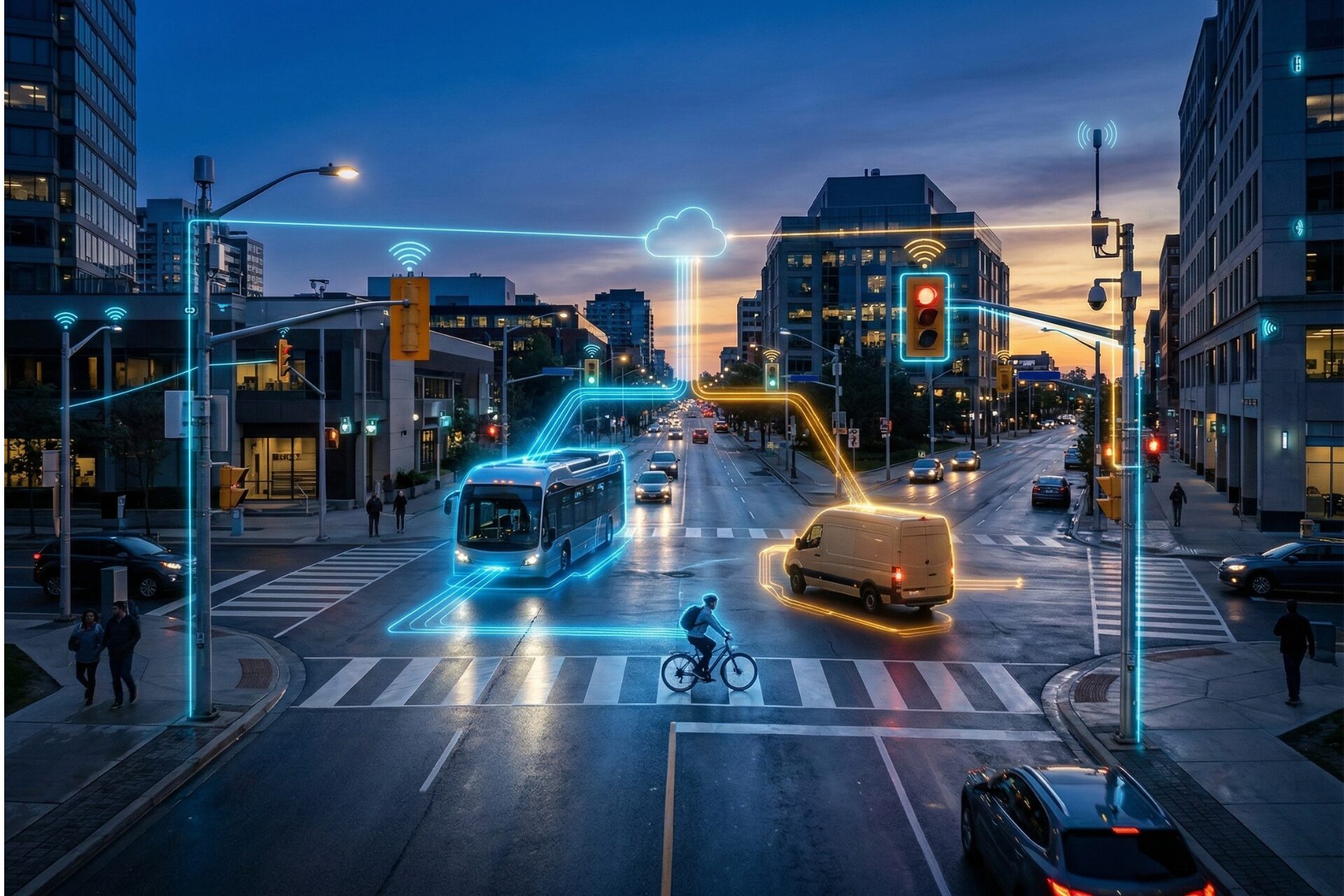
Urban mobility trends in 2026 are moving faster than older transport systems can handle. Learn why traditional traffic management is starting to fail in many cities, what’s driving the pace of change, and how intelligent transportation systems make future-proofing city infrastructure achievable.
Urban city streets have always been complex. But something fundamental has shifted. Urban change is no longer slow or predictable. It’s speeding up in ways older city systems can’t handle.
We see the impact every day: Intersections back up and delays grow. Public transit systems are under heavy strain. Some communities are waiting too long for emergency vehicles to arrive.
For traffic managers and transportation professionals, this creates a growing, urgent gap: The speed of change on the ground is quicker than the decisions being made in response.
Understanding that gap, and what an intelligent transportation approach can do to close it, is the defining infrastructure challenge of urban centers today.
The 5 Forces Accelerating Urban Mobility Today
Urban mobility is not disrupted by a single force. It’s being reshaped by five converging pressures hitting transportation networks simultaneously.
Multimodal Growth
This is fragmenting how people move through urban centers. E-bikes, scooters, heavy electric vehicles, ride-share services, autonomous vehicles, and traditional cars are all competing for the same intersections, signal timing cycles, and communication networks.
Managing a single-mode network was already demanding, but managing five at once across major cities with aging infrastructure requires an integrated approach.
Delivery Traffic
Last-mile and delivery traffic has permanently changed city streets. E-commerce demand has stayed high since the pandemic. Autonomous trucks and frequent delivery vehicles now fill many corridors, often without planning. They create stop-and-go traffic that older signal timing plans did not predict.
As a result, traffic movement along commercial corridors has become noticeably less predictable.
Enhanced Safety Pressure
Safety pressure is rising. Vision Zero goals, pedestrian advocacy, and stronger public scrutiny are growing. Traffic safety is now a clear performance metric, and it can bring real political consequences.
Traffic managers are being asked to demonstrate measurable progress on public safety while managing more complexity with fewer resources.
Staffing Issues
Staffing constraints are limiting institutional capacity. Many transportation systems are doing more with fewer engineers, analysts, and field staff than a decade ago. Manual counts, manual signal changes, and reactive maintenance no longer work at today’s urban scale.
Changing Public Expectations
More than half of the public sector now expects essential services and city infrastructure to be responsive. When public transport runs late, or traffic conditions deteriorate, tolerance erodes quickly. The standard for acceptable performance has risen sharply, even as the complexity of meeting it has grown.
None of these forces would be easy to manage in isolation. Together, they create a compounding problem that changes faster than most transportation systems were designed to respond to.
Image Source: Gemini 2026
Why the Old Approach Breaks at Today’s Speed
The traditional model of traffic flow management was built for a slower world, where data was collected and reviewed manually on timescales of months or years. That approach worked when underlying traffic conditions were relatively predictable.
Today, it creates three critical failure points:
- Latency. By the time field data is processed and used, traffic conditions have already changed. In urban streets, real-time data is not a “nice to have.” It’s required for traffic management that works.
- Silos. Signal operations, public transit scheduling, and public safety monitoring are often managed by separate teams with no shared visibility. When urban mobility trends 2026 shift quickly, siloed transportation systems can’t produce a coherent response.
- Manual workflows. Human-dependent processes can’t scale. The gap between what’s happening on city streets and what the smart traffic management system knows is widening every year.
This is the core of the pace problem. It’s not just that major cities have more traffic. It’s that the decision velocity can’t keep pace with the change velocity.
Image Source: Gemini 2026
Why It’s Solvable Now
Future-proofing city infrastructure has shifted from a goal to a daily practice as four key developments have matured simultaneously.
Connected infrastructure readiness has improved a lot, and more vehicles are sending real-time data. Cloud computing now makes high-end processing affordable for agencies, reducing congestion and improving travel times.
Meanwhile, sensor technology is also more accurate than before, and costs have dropped, which supports wider use. Together, these tools enable continuous and scalable traffic monitoring.
While artificial intelligence is still taking shape, the foundational analytics available today already enable predictive insights that were previously out of reach. Scalable traffic management solutions are no longer exclusive to the largest major cities. Technology adoption has lowered the barriers to innovators improving safety.
The cost curve and capability curve are finally moving in the right direction at the same time, making this a genuine moment of opportunity for traffic managers willing to act on it.
What “Keeping Up” Actually Looks Like
Keeping pace with today’s mobility environment is an ongoing operational posture built around four capabilities:
#1 Proactive Monitoring
Smart city agencies use predictive maintenance and real-time data to identify emerging issues before they become crises. This shift from reactive to proactive is what separates agencies that are future-proofing from those that are perpetually catching up.
#2 Shared Data Across Systems
Breaking down silos means creating a common operating picture for intelligent transportation. When traffic managers can see the full picture, they can make decisions that reduce delays and improve operational efficiency.
#3 Measurable Outcomes
Future-proofing requires connecting decisions to data on improved air quality, enhanced safety, and improved emergency response.
#4 Adaptability by Design
This means building mobility systems that can respond to extreme weather events and integrate emerging technologies without requiring full system replacements. This is what genuine future-proofing looks like.
Legacy Transportation System vs Intelligent Transportation Systems
Feature |
Legacy Transportation Systems |
Intelligent Transportation Systems |
| Data Collection | Periodic manual counts and static snapshots. | Continuous monitoring with real-time data. |
| Response Time | High latency: decisions lag behind conditions. | High velocity: predictive insights for immediate action. |
| Team Structure | Departmental silos with no shared visibility. | Integrated approach across the transportation ecosystem. |
| Scalability | Manual workflows that can’t meet modern demand. | Scalable traffic management solutions for all cities. |
| Outcome Focus | Reactive maintenance after incidents occur. | Enhanced safety and improved emergency response. |
FAQs About Intelligent Transportation Systems
What are the biggest urban mobility trends shaping city transportation in 2026?
Multimodal growth, last-mile delivery traffic, rising traffic safety expectations, staffing shortages, and higher public expectations are the five forces placing the greatest pressure on transportation networks and traffic managers today.
Why are legacy traffic management systems struggling to keep up?
They were built for predictable, slower-moving conditions. Data latency, departmental silos, and manual workflows mean decisions lag too far behind real-time traffic conditions to be effective at today’s pace of change.
What makes intelligent transportation systems more viable now than five years ago?
Cloud computing costs have dropped, connected infrastructure readiness has improved, and sensor accuracy has increased. Together, these shifts have significantly lowered the barrier to adopting scalable smart traffic management system solutions.
How does future-proofing city infrastructure differ from a standard technology upgrade?
Future-proofing city infrastructure is an ongoing operational posture, not a one-time project. It means building transportation systems around continuous monitoring, shared data, predictive insights, and adaptability to emerging technologies and changing traffic patterns.
Key Takeaways
- Urban mobility is being reshaped by five simultaneous pressures: multimodal growth, delivery traffic, rising safety expectations, staffing shortages, and higher public demand for responsiveness.
- Legacy traffic systems weren’t built for today’s pace. Data latency, departmental silos, and manual workflows mean decisions consistently lag behind real conditions.
- The gap isn’t just about more traffic; it’s a mismatch between how quickly conditions change and how quickly transportation agencies can respond.
- Four technological shifts, namely, better connected infrastructure, lower cloud costs, improved sensors, and emerging AI analytics, have made intelligent transportation systems accessible to cities of all sizes.
- Future-proofing isn’t a one-time upgrade. It’s an ongoing operational posture built on proactive monitoring, shared data, measurable outcomes, and systems designed to adapt.
- Agencies that act now have a genuine window of opportunity, as costs and capabilities are finally moving in the right direction simultaneously.
Future-Proofing City Infrastructure with Miovision One
Miovision provides innovative solutions through a platform built around continuous, intelligent transportation operations. From real-time intersection monitoring to actionable insights, the tools to close the gap between change velocity and decision velocity are available now.
Explore how leading transportation networks are using intelligent mobility as the foundation for more resilient city infrastructure.
Solution Spotlight: Miovision One