
Overcome intelligent mobility barriers by looking beyond the tech. Learn how to navigate city transportation challenges, secure smart city funding, and align stakeholders to ensure your smart city implementation moves from a successful pilot to a scalable urban reality.
The pattern is becoming all too familiar for transport agencies and city professionals. Many cities secure grants and launch successful pilots only to see them stall before scaling. If the budget is there and the technology works, what’s actually in the way?
The barrier isn’t a lack of innovation; it’s intelligent mobility barriers like procurement friction and misaligned incentives. Leaders who misdiagnose these barriers waste years chasing the wrong fix while congestion levels continue to rise.
Three Barriers, One Diagnosis
To solve city transportation challenges, we have to stop acting like some problems are more important than others. While they’re all linked, we can’t wait to solve one before starting on another. They all need their own specific solutions at the same time.
Here’s why ‘smart city’ projects usually fail to grow:
1. Money: The Budget Structure Trap
When we talk about mobility funding for cities, the issue is rarely just the total dollars. The real friction is in infrastructure decisions and budget design.
- CapEx vs. OpEx: Many big cities can buy physical assets (Capital Expense), but struggle to fund software (Operating Expense) that makes those assets smart.
- Grant mismatches: Federal grants often cover the initial installment, but rarely include long-term maintenance. This can leave cities with orphan technology.
- ROI language: Smart transport ROI can look different to each role. A traffic engineer and a finance director may not agree. If you can’t turn time saved into cost savings, funding may be cut off. Many cities now explore public-private partnerships to fill gaps and support sustainable transport.
2. Politics: The Stakeholder Alignment Gap
In smart city initiatives, politics is not about corruption, but the hard task of aligning public transportation stakeholders. Policy makers need to balance the needs of private vehicles while also expanding access to public transport systems.
- Loss aversion: Transitioning to high-tech transit requires an organizational culture that values learning and adaptation. When the path to managing new systems is clear and supported, departments feel more empowered to innovate rather than sticking to the status quo.
- Credit sharing: If Miovision Opticom improves emergency response times, does the credit go to the Fire Department or the Traffic Operations team? When departments don’t share credit, they often don’t share data.
3. Technology: The Solvable Constraint
It’s time for an honest admission: technology is the easiest of these three problems.
Legacy system lock-in and data format issues are real. Still, modern platforms like Miovision One are built to last. This shows tech issues are often signs of weak procurement specs.
A Quick Self-Assessment: What’s Your Primary Constraint?
Use this three-scenario diagnostic to identify where your smart city implementation is truly stuck.
Observation |
The Likely Diagnosis |
| The pilot was a technical success, but we can’t get approval to roll it out city-wide. | Politics/Governance Problem |
| We know what we need, but the request for proposal (RFP) has been “under review” by legal or finance for 12 months. | Procurement/Money Problem |
| We bought the equipment, but it won’t connect to our existing networks or to our central software. | Technology Problem (Check procurement specs first) |
How to De-Risk Each Barrier
Overcoming these hurdles requires a single, decisive move for each category to ensure sustainable transport for everyone.
Money: Frame Around Avoided Cost
Stop selling smart tech and start selling risk reduction. Identify which funding pots, such as Vision Zero funding or federal transportation grants, apply to your specific safety goals.
Design your pilots with clear cost-per-outcome metrics. For example, track cost per avoided accident, not just cost per sensor. This approach is key to the economic success of any smart city.
Politics: Map the Coalition Early
Define shared outcomes before you define shared systems. If you’re implementing transit signal priority to help public transit systems, bring the Transit Authority and the City Council into the room on day one.
Use data transparency to build trust; when everyone has access to the same source of truth, the fear of accountability diminishes.
Technology: Demand Interoperability
Avoid single-vendor lock-in by specifying open APIs and data export standards in your traffic technology procurement language.
Ensure your platform, such as Miovision One, is an all-in-one environment that can evolve alongside your city’s changing needs and existing networks.
Integrating Public Transportation
Many transit systems have low ridership due to limited coverage in low-density areas. Smart mobility tools can help cities use demand-responsive transport to fill these gaps. This improves transit access for vulnerable groups and reduces the need for private vehicles.
- Light rail and buses: Coordinating light rail schedules with bus transit systems ensures a seamless journey for commuters.
- Micro mobility: Integrating micro-mobility options like e-scooters into the public transport network helps address the first- and last-mile problem.
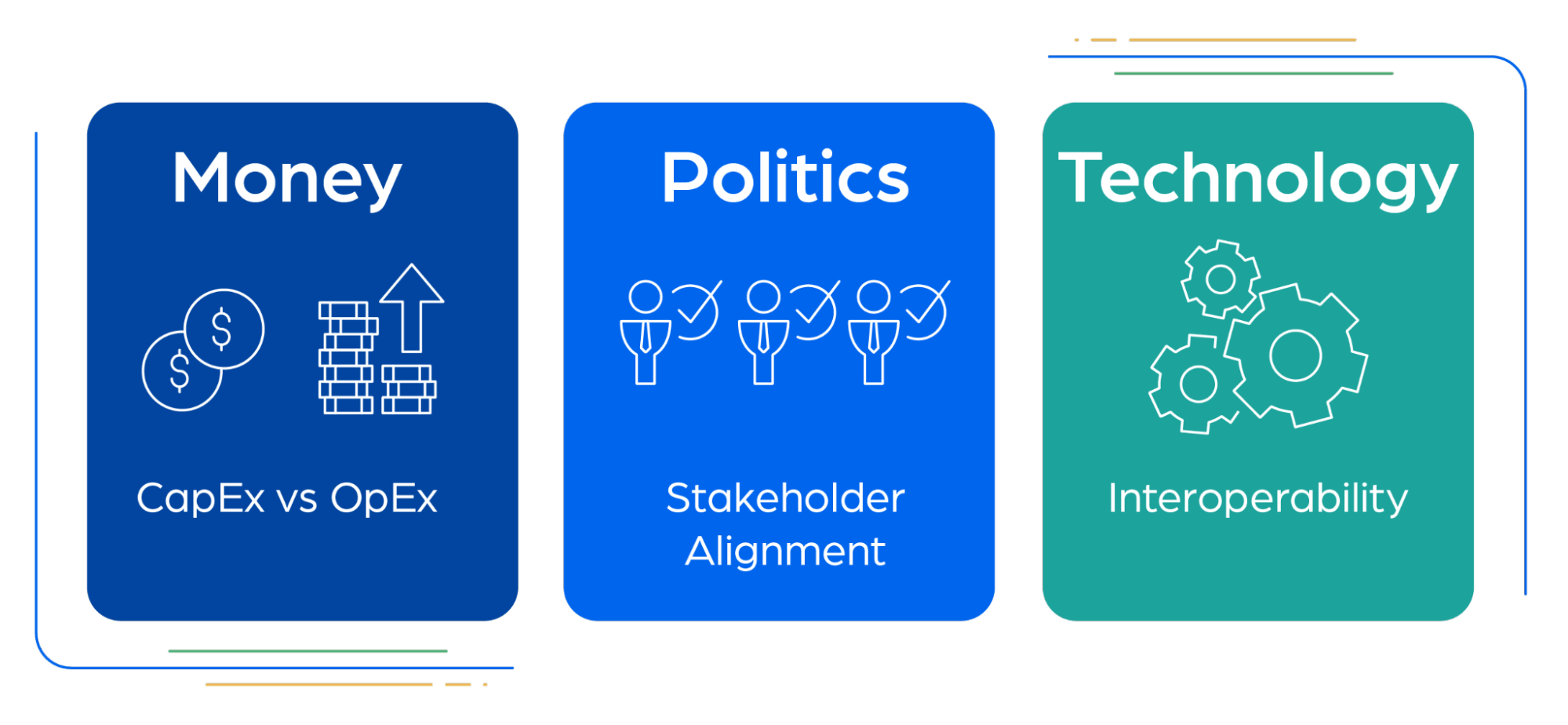
Image Source: Gemini 2026
The Coalition Map: Who Needs to Say “Yes”?
In any urban mobility project, each stakeholder has unique concerns key to public-sector innovation. Here’s who to go to for city-level decisions and ensure transportation stakeholder alignment:
- Traffic operations: System reliability and existing signal coordination.
- Transit authority: Ensuring many transit systems maintain schedules and increase public transit access.
- Emergency services: Reliability for life-and-death emergency vehicle preemption.
- IT/CIO: Data security, cloud standards, and data governance.
- City legal: Data ownership and liability for private vehicles and vulnerable groups.
- City council: Reducing congestion during peak hours for constituents.
FAQs About Intelligent Mobility Barriers
Why do so many smart city pilots fail to scale?
They stall due to political misalignment and rigid traffic technology procurement rather than technical flaws.
How can cities fund intelligent public transit systems?
By using Vision Zero funding, climate grants, and public-private partnerships, while framing technology as a long-term cost reducer.
What are the biggest challenges in traffic technology procurement?
Traditional RFPs are too rigid for new technologies. Success needs a clear focus on interoperability requirements.
How do we align stakeholders for mobility projects?
Identify specific concerns early and use data transparency to build trust across departments.
Key Takeaways
- Tech isn’t the blocker: Modern smart city projects rarely stall because of software. The real mobility barriers are slow procurement and low risk tolerance.
- Funding vs. structure: Budget issues often stem from a mismatch between capital grants and long-term operating costs for smart mobility systems.
- Coalition alignment: Successful urban mobility projects require early buy-in from diverse stakeholders, including IT, legal, and emergency services, to move beyond pilot stages.
- Interoperability is essential: To avoid vendor lock-in, cities must prioritize open APIs and integrated networks in their traffic technology procurement language.
The First Move
Cities aren’t held back by bad technology, but by a lack of clarity on which problem they’re solving. Whether the goal is reducing environmental impacts, improving air quality, or moving toward mobility-as-a-service, clarity is the first move.
Once you diagnose the real barrier, you can stop fighting the tools and start moving the needle.