

Many cities are still managing modern road networks with legacy traffic control systems built for a simpler era. Outdated systems, manual traffic data collection, and reactive workflows are driving up costs, creating safety gaps, and leaving transportation agencies perpetually behind.
In 1999, the world was preoccupied with Y2K and the novelty of the internet. While our personal technology has advanced, many cities are still operating 2026 road networks with legacy traffic control systems built for a simpler time.
Running a modern city on outdated systems is not just an inconvenience; it’s a serious problem that needs to be addressed. Much like aging water pipes, outdated urban infrastructure often fails out of sight until a major break occurs, leading to rising traffic signal maintenance costs and reactive workflows.
Think about how much the roads have changed since 1999. Back then, traffic signals were simple, and traffic volumes were largely predictable. Today, your roads carry e-scooters, delivery robots, ride-share vehicles, and autonomous shuttles. These different vehicle types create layered complexity at every intersection.
Managing this multimodal demand with outdated systems incurs measurable cost in safety, congestion, and public trust.
What ‘1999 Mobility’ Looks Like in Practice
Legacy traffic control systems are still the operational backbone for most mid-size and large cities. Engineers at agencies of all sizes often work from signal timing plans last updated years ago. The scope of the problem is most obvious when collecting data.
A typical traffic data collection project generally unfolds like this:
Engineers deploy tube counts or conduct manual turning movement counts at a few locations
⬇
Staff spend days in the field collecting information on traffic volumes and turning movements by direction
⬇
That data is then manually processed, a method that generally takes weeks from setup to final report.
This process is neither cost-effective nor scalable. Traffic flow can shift dramatically between the time a study is commissioned and when the results arrive. By the time a fix is ready, the conditions have changed.
Cities are not managing traffic so much as reacting to a snapshot of it. Manual traffic data collection issues also create documentation gaps, where near-miss incidents and failures go unrecorded.
What Changed: Multimodal Demand and Budget Scrutiny
The mobility landscape of 2026 bears little resemblance to the one these outdated systems were built for. Three forces have accelerated the need for a proactive approach:
- Network complexity: It’s no longer just cars. Engineers must account for pedestrians, cyclists, and connected vehicles. Capturing this full picture of speed and turning movements requires sensors that legacy setups lack.
- Staffing constraints: Experienced engineers are retiring, and the institutional knowledge they carry is not easily transferred to younger staff who inherit outdated systems.
- Budget scrutiny: Maintenance costs are rising as older equipment reaches end-of-life. Emergency repairs are becoming a regular line item, yet it is hard to justify capital investment without continuous data.
The Hidden Costs of Reactive Operations
The true cost of reactive traffic management is distributed across departments and communities.
- Safety: Without continuous monitoring, dangerous patterns persist for years. Real-time analysis could surface signal timing that disadvantages pedestrians before an incident occurs.
- Congestion: A corridor running the same sequence for years cannot adapt to moving demand peaks. This results in wasted time and higher emissions.
- Credibility: When a city takes months to respond to a safety concern, public confidence erodes. Residents sitting in congestion every morning can see that the infrastructure is not being actively managed.
- Litigation exposure: Cities that cannot demonstrate they were monitoring a known problem, or that they acted promptly when data indicated risk, face real vulnerability.
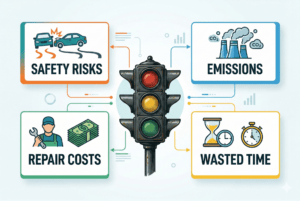
Image Source: Gemini 2026
The New Baseline: What Cities Need Now
Modernizing traffic operations is about efficiency and progress, not just technology for its own sake.
Continuous monitoring is the foundation. Cities need automated traffic data collection that provides a live view of intersection behavior, traffic volumes, and vehicle types. Modern sensors can capture this without the manual delays of legacy methods, eliminating the most critical gap in how cities understand their networks.
Interoperability is the second pillar. Modern infrastructure must pull from multiple sources into a single view so engineers can discover patterns and map improvements without having to map data across disconnected systems.
Finally, a proactive approach allows agencies to move from silos to shared situational awareness.
Future-proofing your city does not require tearing out every legacy component overnight. But it does require acknowledging that every year spent on outdated systems is another year managing a 2026 network with 1999 capacity.
The True Cost of Analog Traffic Management
Infrastructure lag rarely shows up as a single line item.
It shows up as the emergency repair that wasn’t budgeted, the safety complaint that sat in a queue for six months, the signal timing plan nobody has touched since the last administration.
For departments still running on analog traffic management, whether that means manual counts, paper reports, or sensors that don’t talk to each other, the gap between what they know and what’s actually happening on the road widens a little more every day.
- Reactive budgeting: When outdated systems fail, agencies spend on emergency repairs instead of planned improvements. Money that could go toward future infrastructure gets absorbed by yesterday’s problems.
- Data silos: Analog traffic management traps data in physical files or incompatible software. There is no shared picture of traffic flow across the city, so decisions are made in isolation, often too late.
- Safety blind spots: Turning movement counts takes weeks to process. In the meantime, a dangerous pattern at a high-risk intersection keeps repeating, undetected and unaddressed.
FAQs About Legacy Traffic Control Systems
Why are traffic management systems still in use if they’re outdated?
Let’s be honest: replacing aging infrastructure is a massive capital investment. Many agencies find themselves in a “Catch-22” where they lack the continuous monitoring data needed to build a winning business case for funding, so outdated systems persist by default.
How much do traffic signal maintenance costs actually impact city budgets?
It’s the difference between a planned oil change and a blown engine. As traffic signals reach the end of their lifespans, the city budget shifts from planned maintenance to costly emergency repairs. These unplanned failures are not just a headache; they’re significantly more expensive to address than a proactive approach would be.
What’s the difference between manual traffic data collection and continuous monitoring?
Manual traffic data collection is a snapshot in time that quickly becomes irrelevant. Continuous monitoring is a live, high-definition stream that tracks traffic volumes, turning movements, and various vehicle types around the clock.
How do outdated systems affect road safety?
Without continuous monitoring at the intersection, dangerous patterns, like frequent near-misses or poor sightlines, go undetected until a reportable crash occurs. Having real-time insights enables agencies to identify and address these risks before they escalate into emergencies.
Key Takeaways
- Legacy traffic control systems rely on manual data that produces outdated traffic volumes and reactive traffic management
- Maintenance costs skyrocket as outdated urban infrastructure ages, while a lack of monitoring allows failures to go undetected.
- Moving toward a proactive, real-time approach is the fastest way to reduce congestion and save lives.
- Modern technology, like the Miovision One platform, provides the efficiency and capacity needed to manage today’s complex multimodal demand.
Bridging the Gap: Moving Beyond the Status Quo
Every city reaches a tipping point where the “old way” of doing things stops being a minor inconvenience and starts being a liability. For most agencies, that moment arrives when analog traffic management simply cannot keep up with the demand of a 2026 road network.
When you’re working with traffic signals optimized for traffic volumes from three years ago and turning movement counts that take weeks to process, you’re dealing with a massive infrastructure lag.
Miovision One was built to break this cycle. By replacing infrastructure lag with continuous monitoring, we give engineers the real-time insights they need to stop reacting and start leading.
Suddenly, signal timing is optimized for what is happening now. Safety patterns surface before they become tragedies. Most importantly, you finally have the data to build a credible, cost-effective case for the investments your community deserves.
Our goal isn’t technology for its own sake; it’s a city that moves better, in every direction, for everyone on the road.